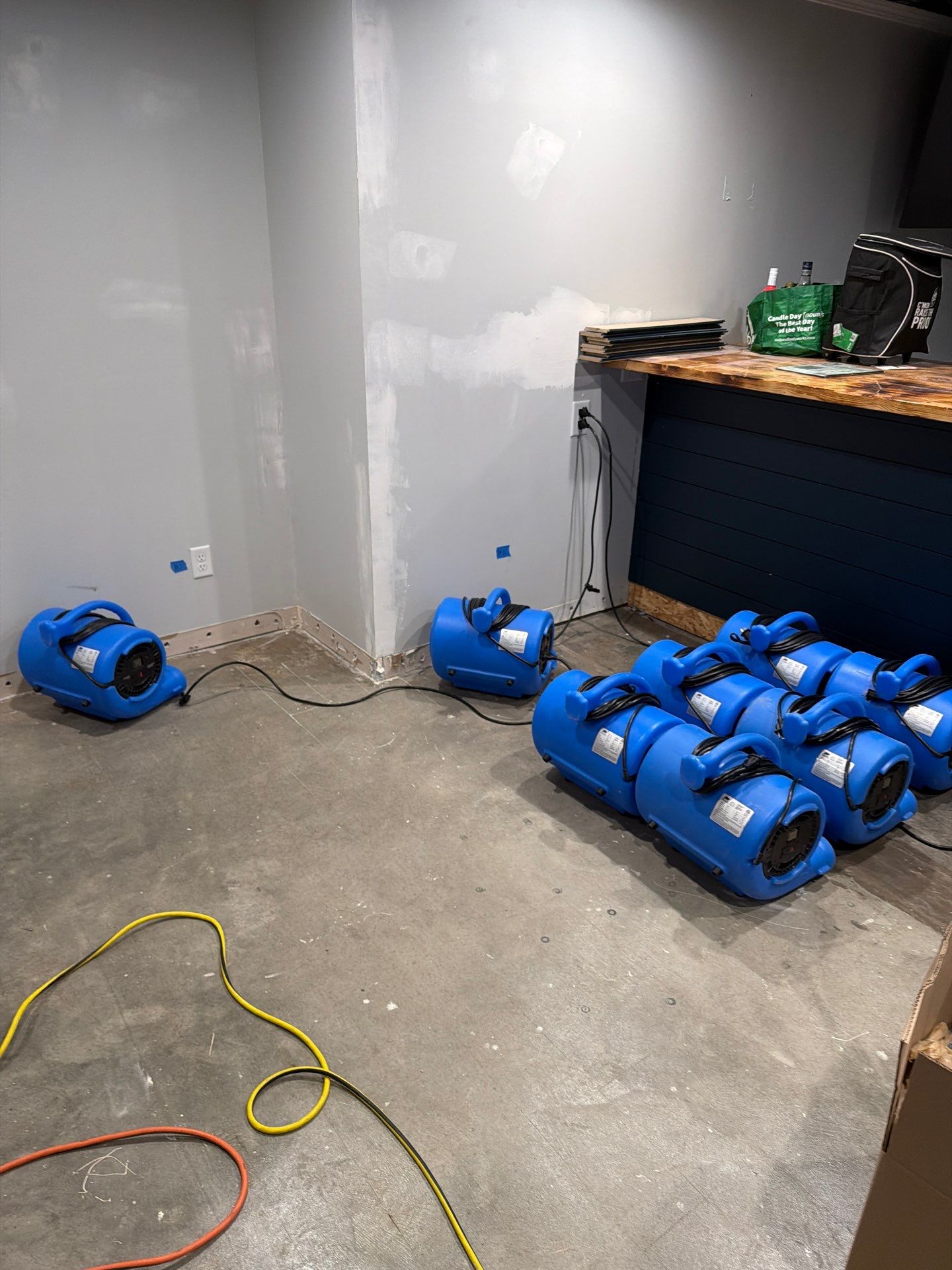
Step by-Step Professional Dry-Out Timeline
Below is the exact sequence our IICRC certified technicians execute on a standard Category 1 or Category 2 loss in Rocky Ripple. Category 3 losses follow the same drying logic but include demolition and antimicrobial steps covered in our black water cleanup protocol.
Step 1: Dispatch and Arrival (Hour 0 to 2)
- Call received, job logged, crew dispatched.
- Arrival on site in most cases within 2 hours.
- Safety walk: electrical shutoff verification, slip hazards, structural check.
- Source confirmation: leak stopped or isolated before any drying begins.
- Personal protective equipment selected based on suspected category (nitrile gloves, N95 minimum, full Tyvek for Category 3).
- Initial photos taken for the insurance file before any contents are moved.
Step 2: Inspection and Moisture Mapping (Hour 2 to 4)
- Thermal imaging scan of all affected walls, ceilings, and floors.
- Pin type moisture meter readings on wood framing (target: under 16 percent).
- Non invasive meter readings on drywall (target: under 1 percent scale value).
- Hygrometer readings for ambient temperature and relative humidity.
- Affected area sketched with moisture map and category classification (1, 2, or 3).
- Class of loss assigned (Class 1 through 4) to size equipment correctly.
- Written scope shared with you and your insurance adjuster.
Step 3: Water Extraction (Hour 4 to 8)
- truck mounted or portable extractors deployed based on volume.
- Standing water removed at 100 to 200 gallons per hour per unit.
- Weighted carpet extraction passes: minimum 3 slow passes per affected square foot.
- Pad removal if Category 2 or saturation exceeds 50 percent capacity.
- Wet vacuum follow up on hard surfaces and corners.
Extraction is the highest leverage step. Every gallon pulled mechanically saves roughly 24 hours of evaporative drying time. Details on this phase are covered in our water extraction service breakdown.
Step 4: Controlled Demolition (Hour 8 to 12, if required)
- Baseboard removal in saturated zones.
- Drywall flood cuts at 2 inches or 4 feet, based on wicking height measured.
- Wet insulation bagged and removed (R-value lost permanently when saturated).
- Engineered flooring or laminate lifted if subfloor readings exceed 16 percent.
- Cavity ventilation holes drilled behind baseboards when full cuts are not needed.
- Cabinet toe kicks removed to expose hidden saturation under sink bases.
- Debris weighed and logged for disposal documentation.
Step 5: Equipment Setup and Drying Chamber (Hour 12 to 24)
- Air movers placed at 1 unit per 50 to 60 linear feet of wet wall, angled at 10 to 45 degrees.
- Low grain refrigerant (LGR) dehumidifiers sized at 1 unit per 100 to 150 square feet of Class 2 loss.
- Target chamber conditions: 70 to 90 degrees Fahrenheit, relative humidity under 40 percent, GPP (grains per pound) differential at least 30 below outside air.
- Plastic containment installed to isolate the drying chamber from the rest of the home.
- HEPA air scrubbers added for Category 2 or any visible microbial concern.
- Power load calculated: typical setup pulls 15 to 25 amps; circuits balanced to prevent breaker trips.
- Hardwood floor mat systems connected when finished flooring is salvageable.
- Injectidry panels installed on wall cavities to push warm dry air behind sheetrock without full demolition.
Step 6: Daily Monitoring (Days 2, 3, 4)
- Technician returns every 24 hours.
- Moisture readings logged at the same mapped points each visit.
- Dehumidifier reservoir checked and drained.
- Air mover repositioning based on drying rate (slow zones get more airflow).
- Daily drying log uploaded to your insurance file.
- Equipment reduced as readings approach dry standard, not all at once.
- Photos taken at each visit and timestamped for the claim record.
Expected daily moisture reduction in framing: 2 to 4 percentage points per day under proper conditions. If readings stall for 48 hours, we reassess containment, airflow, and hidden saturation. Stalled drying often means trapped moisture behind a finish, which is why we use the same inspection methods covered in our guide to hidden moisture detection.
Step 7: Verification and Equipment Removal (Day 3 to 7)
- Final moisture readings on all mapped points.
- Dry standard confirmed: framing under 16 percent, drywall at unaffected baseline, concrete within 4 points of reference.
- Equipment removed only after two consecutive dry readings 24 hours apart.
- Containment dismantled, surfaces wiped down.
- Final report issued with before and after readings.
- Reconstruction scope handed off if rebuild services are part of the claim.
Typical Total Dry-Out Durations
- Small Category 1 loss (one room, clean water, fast extraction): 2 to 3 days.
- Standard Category 1 or 2 loss (multiple rooms, 500 to 1,500 sq ft): 3 to 5 days.
- Hardwood floor drying with floor mat systems: 5 to 10 days.
- Plaster or lath walls: 5 to 8 days.
- Concrete slab drying: 7 to 14 days depending on thickness and sealer.
- Crawl space dry down: 4 to 7 days with sealed containment.
- Category 3 loss with demolition: 4 to 7 days drying after demo complete.
- Multi floor losses with vertical migration: 6 to 10 days due to ceiling cavity drying.
- Tile over slab with mud bed: 8 to 12 days due to low permeability.
What You Can Do to Help the Process
- Keep interior doors open in the drying chamber unless told otherwise.
- Do not turn off air movers or dehumidifiers, even at night.
- Avoid running the home HVAC system in cooling mode below 70 degrees during active drying.
- Keep pets and children out of the contained area.
- Move undamaged contents at least 3 feet away from wet walls.
- Report any new leaks, sounds, or odors to the lead technician immediately.
- Save photos of damaged contents before discarding for the claim file.
The dry out phase sets up everything that follows, from reconstruction to final inspection. Following the sequence above, most residential losses in Rocky Ripple finish drying in 3 to 5 days, with verification documented for your insurance carrier on the same day equipment is removed.
Factors That Extend the Timeline
- Delayed start: every 24 hours of delay adds roughly 1 day to the schedule.
- Cold ambient temperatures under 60 degrees slow evaporation.
- Closed cavities without ventilation holes.
- Saturated insulation left in place.
- Undersized dehumidification.
- Power interruptions to drying equipment.
- Dense materials like plaster, brick veneer, or double layer drywall.
- High outdoor dew points during humid Rocky Ripple weather windows.
- Homeowner run HVAC pulling humid air into the chamber.
- Vapor barriers (foil backed insulation, vinyl wallpaper) trapping moisture behind the surface.
How Rocky Ripple Water Restoration Shortens the Timeline
- Crew arrival in most cases within 2 hours of the initial call.
- truck mounted extraction units sized for high volume removal on the first visit.
- LGR and desiccant dehumidifiers staged in service vehicles, not ordered after inspection.
- Direct billing to your insurance carrier so paperwork delays do not pause work.
- Daily moisture logs delivered electronically to your adjuster within 12 hours of each reading.
- Cross trained technicians who can transition from extraction to demolition without a second mobilization.